Featured Research
If following our process for Acknowledging the WFU HPC Facility properly, all publications which reference the DEAC Cluster’s DOI should be found on Google Scholar.
Beyond publications, if you have links to posters or presentations you would like to provide, please share them so we reference them here!
Furthermore, if you would like to be interviewed for a Featured Research video, please send us a brief blurb about your project, relevant publication info, and what you would like to talk about.
Green Jobs Economic Impact with Mark Curtis
Watch our research highlight video on Environmental Economic Research on the DEAC Cluster!
Machine Learning with Nathan Whitener
Watch our research highlight video on Undergraduate Research with Machine Learning on the DEAC Cluster!
Data Mining with Sarah Parsons
Watch our research highlight video on Data Mining on the DEAC Cluster!
Structural Comparison of ATP-binding Effects
An illustration of the structural effects of ATP binding on DNA-bound MutS structures. The binding of a second ATP to MutS causes conformational changes, illustrated by color, blue for the largest conformational changes, green for intermediate changes and red for the smallest changes. The MutS comples is the prokaryotic equivalent to the MSH2/MSH6 complex, which are key mismatch repair proteins functioning in both cell death and repair pathways. Conformational changes in MSH proteins are critical to the regulation of these pathways.
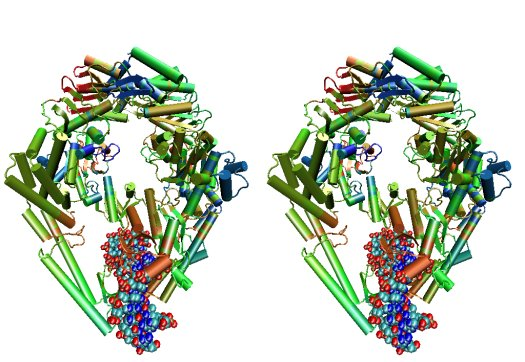
This research was conducted on the DEAC cluster by Professor F. Salsbury of the Physics department who collaborates with the Scarpinato Lab in the Cancer Biology department.
Fibonacci and Phi
One of the first attention getting efforts put for by the cluster was a collaboration between Wake Forest University faculty and performing arts groups. While this page showcases those past collaborations, we are always open to exploring new, extreme, and unconventional uses of high performance computing capabilities in works of visual and performing arts as well as other disciplines in the Humanities.
Fibonacci and Phi: Free Space 2003

As part of a collaboration between the Alban Elved dance company and the Wake Forest University Computer Science Department, “Fibonacci and Phi: Free Space 2003” combines the realms of art and science into a single performance. Inspired in part by Wake Forest University’s 2003-2004 Theme year focus “Fostering Dialog: Civil Discourse in the Academic Community”, the performance challenges the notions of apparent conflict between the arts and the sciences.
Of direct relevance to the WFU DEAC Osiris cluster, the performance uses real time generation of fractal images. The dancers trigger particular actions (zoom, move up, move down, etc.) on the stage through laser beam sensors that are converted to MIDI signals. These MIDI signals are captured on-stage and forwarded to the cluster. A MPI-based Mandelbrot program receives the signals, calculates the fractal image, and ports the X-Windows graphics back to the on-stage system where it is displayed.
Three nightly performances took place from December 4-6, 2003 and one matinee performance was held on December 7, 2003. Following each performance, the members of the production would hold a question and answer session to address issues related to the production, ranging from technical details to guiding themes of the event. In addition, two afternoon forums were held in conjunction with the production to further the dialogue.
In addition to the performances, the scientists (Drs. Jennifer Burg and Timothy Miller involved in the project presented a paper, “Cluster Computation in Step with Real-Time Dance”, to the International Society for Computers and Their Applications 17th International Conference on Parallel and Distributed Computing Systems (PDCS-2004).
Computer Modeling of Crystalline Electrolytes
Department: Physics Author(s): N.D. Lepley, N. A. W. Holzwarth
Notes/Questions/Thoughts:
Does electron localization play a role? Doesn’t seem to be relevant
Van der Waals interactions? No
Climbing image NEB vs. regular
Supercell size effects